Aluminium with hidden fixings or profiled steel: comparison, ventilated facade, quantities and installation of metal...

Latest posts
-
 Metal facade cladding: aluminium or steel?Read more
-
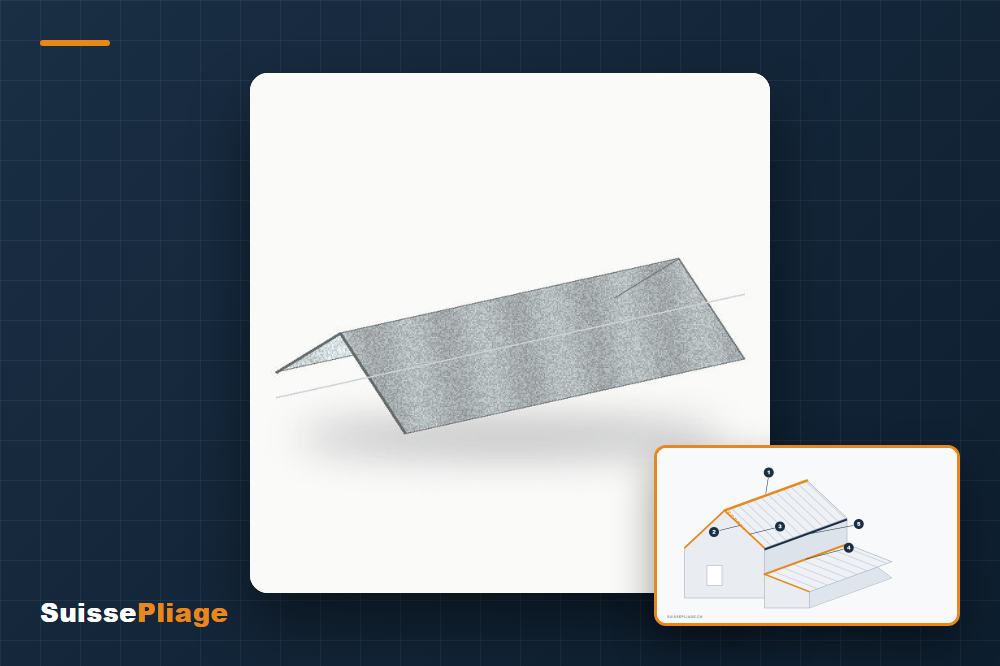 Metal roof flashings: ridge, verge, wall flashing and fillersRead more
Ridge, verge, wall flashing, filler, hip, fascia: what each metal roof flashing does, where it goes and how much to...
-
 Steel roofing sheets: choosing the profile, pitch and fittingRead more
Profiles 29C, 850+, 35C or 45C, pitch, condensation, overlaps and fixings: the guide to choosing and fitting a steel...
-
 Aluminium window sill: measurements, slope and installationRead more
At least 5° of slope, a 30–50 mm projection, a drip edge and upstands: the complete guide to measuring, choosing and...
-
 DEV 33 half-round gutter accessories: installation guideRead more
Accessories for DEV 33 Ø 100 mm half-round gutters: fascia brackets, outlets, 90° angles, stop ends – selection and...
-
 DEV 33 half-round gutter and accessories: a complete guideRead more
Discover the complete range of half-round gutters developed by SuissePliage — brackets, outlets, downspouts, water...
-
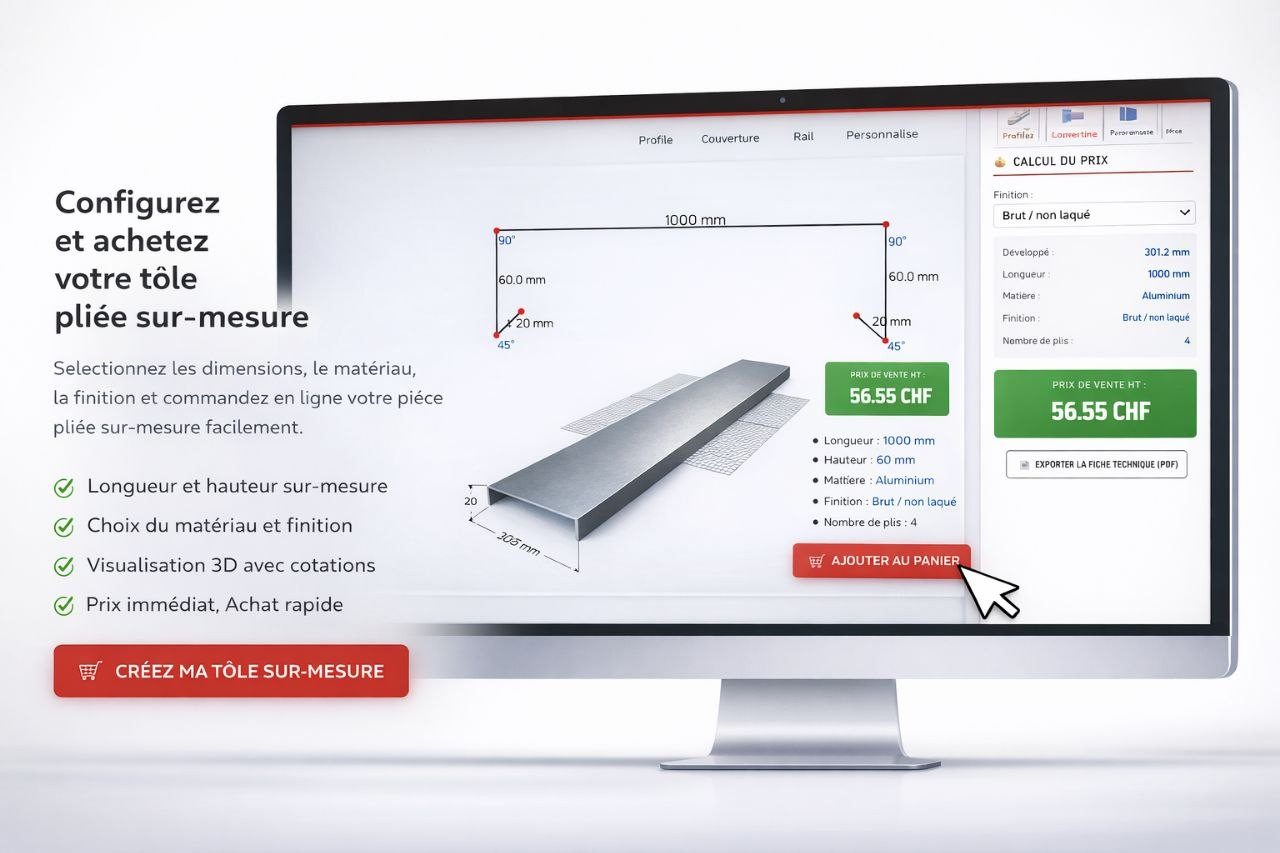 Order custom bent sheet metal onlineRead more
Find out how to order your custom bent sheet metal in 3 minutes with the SuissePliage configurator: 20 profiles,...
-
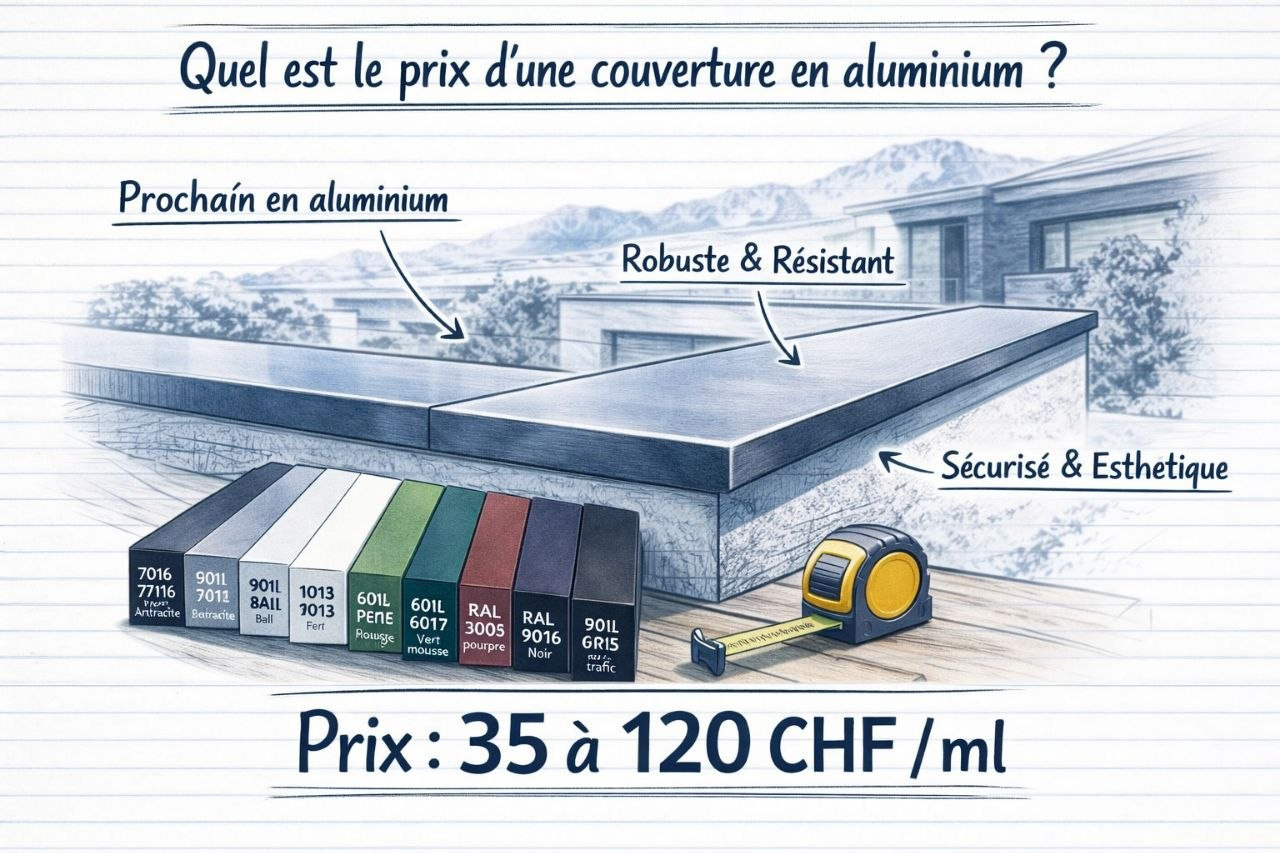 What is the price of an aluminium coping in Switzerland?Read more
What is the price of aluminum coping in Switzerland in 2026? Ranging from CHF 35 to 120 per linear meter depending on...
-
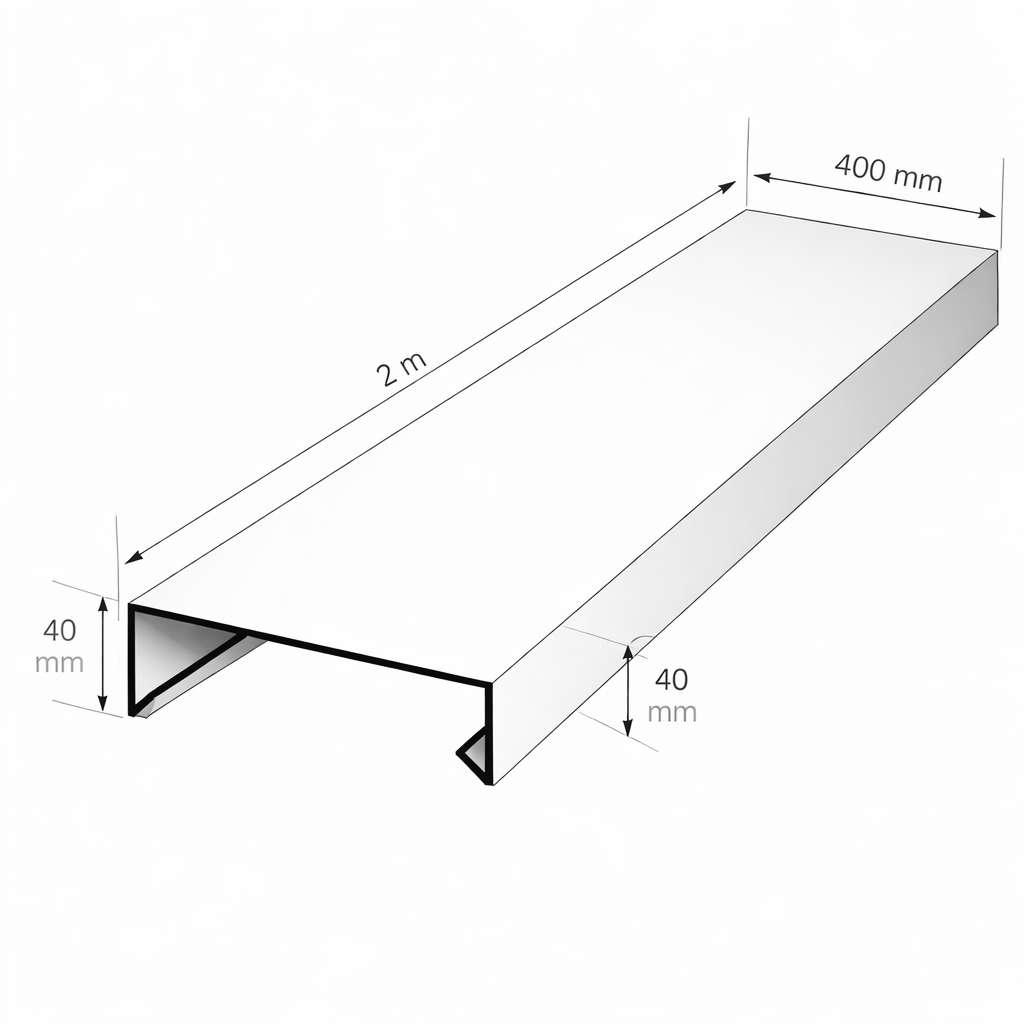 How to Choose the Right Coping Width for Your Parapet?Read more
Series 150, 200, 250, 300 mm... How to choose the right coping width? This guide explains everything in 5 minutes.
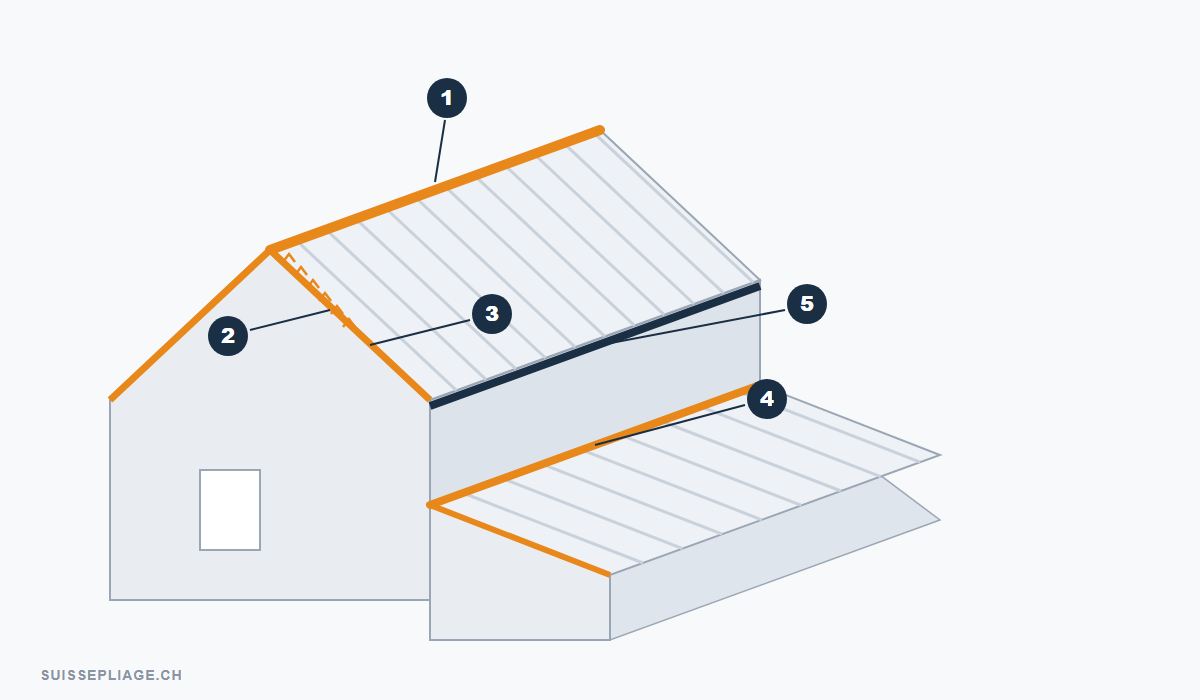
Metal roof flashings: ridge, verge, wall flashing and fillers
Sheet metal guide 2026
Metal roof flashings
ridge, verge, wall flashing
ridge, verge, wall flashing
A metal roof is only watertight if its edges are. At the top, along the sides, against a wall or along a hip: every line has its own folded part. This guide explains what each flashing does, where it goes and how to work out what to order.
✅
The short answer
The ridge covers the top of the roof, the profile filler closes the ribs under the ridge, the verge protects the side edges, the wall flashing joins the roof to a wall and the hip covers the sloping lines between two roof slopes. All come in 2 m lengths.
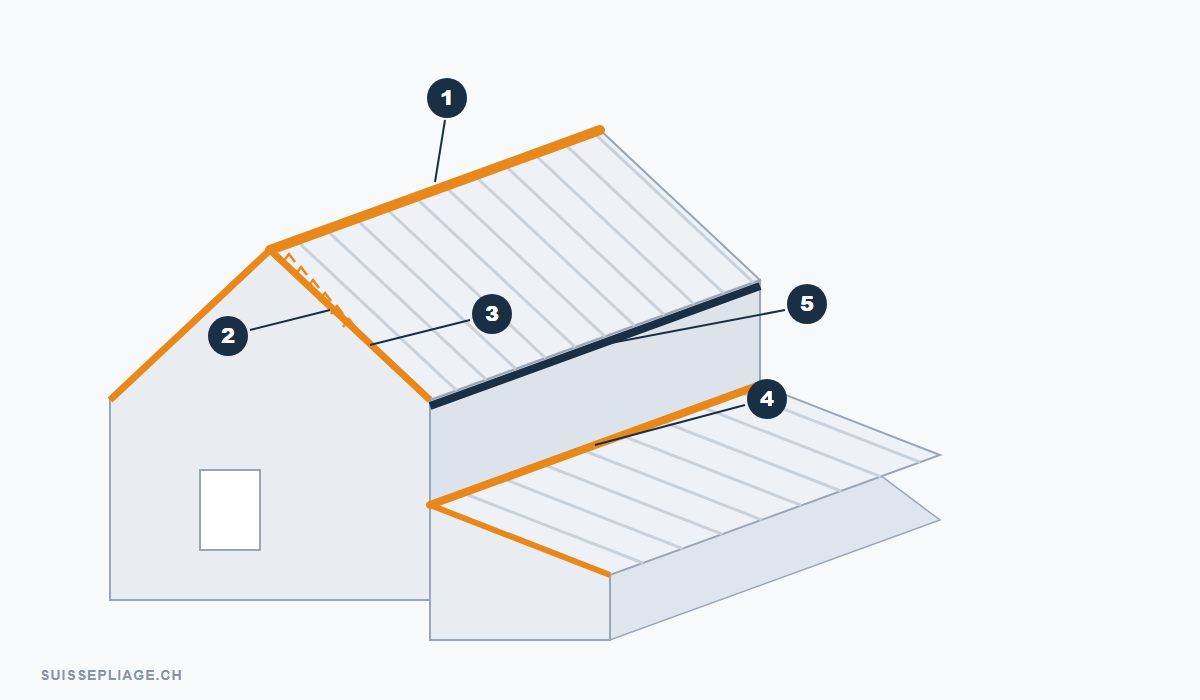
1 double ridge · 2 profile filler · 3 verge · 4 ridge flashing against the wall · 5 fascia.
At the top: ridges
| Part | Where | Purpose |
|---|---|---|
| Double ridge | Top of a dual-pitch roof | Covers the joint between both slopes (no. 1) |
| Mono-pitch ridge | Top of a single-slope roof | Protects and finishes the high point |
| Wall ridge flashing | Top of a lean-to roof against a wall | Ridge with an upstand against the wall (no. 4) |
| Half ridge with notched bead | High edge, asymmetric junction | Neatly closes the top of a slope |
Under the ridge, the notched profile filler (no. 2) follows the shape of the ribs: it stops driving rain, powder snow and birds while letting air circulate.
Along the edges: verges and fascias
Verge
Closes the side edge of the roof at the gable and protects it from rain, wind and snow. See the verge
Verge wall flashing
When a roof edge runs along a wall, it turns up against the wall for a watertight junction. See the wall flashing
Fascia
Covers an edge, a verge, a parapet or a facade with a flat, straight face. See the fascia
Sloping lines: hips
On a hipped or multi-slope roof, the hip covers the sloping line where two slopes meet. The double hip covers both sides; the half hip is used for partial junctions and corner finishes.
Small parts that make the difference
- The end cap closes off the end of a flashing, verge or wall flashing at the side.
- Joint straps connect two lengths of profile for a clean, watertight joint.
- For the finish under a window, see our guide to the window sill.
Working out and ordering
1
Measure each line
Length of the ridge, each verge, each wall flashing and each hip, in metres.
2
Allow for the laps
2 m parts lap by about 10 cm. So count 1.90 m of useful length per part: a 9 m ridge needs 9 ÷ 1.9 = 4.7, so 5 ridge pieces.
3
Use the same material
Stay with the same metal family as the roof covering to avoid galvanic corrosion. Colours are available in RAL aluminium and zinc finishes (metal characteristics).
4
Made to measure if needed
If the shape or size of your roof is non-standard, draw the part in the configurator: free dimensions and instant price.
Laying a steel sheet roof? Our guide to steel roofing sheets covers profile choice, pitch and installation.
All roof flashings
Ridges, verges, wall flashings, fillers and hips in 2 m.
→ Draw a made-to-measure part in the configurator
Frequently asked questions
Q
What is the difference between a ridge and a profile filler?
The ridge is the part that covers the top of the roof. The profile filler sits beneath it: it follows the ribs of the sheet to close the gaps between the roof covering and the ridge.
Q
What is the difference between a verge and a verge wall flashing?
A verge finishes a free roof edge at the gable. A verge wall flashing is used when the roof edge runs along a wall: it turns up against the wall for a watertight junction.
Q
Double or mono-pitch ridge: which one?
A double ridge covers the top of a dual-pitch roof. A mono-pitch ridge finishes the top of a single-slope roof. If that top edge is against a wall, choose a wall ridge flashing.
Q
How many ridge pieces do I need?
Count 1.90 m of useful length per 2 m part, because of the lap of about 10 cm. A 9 m ridge needs 5 pieces.
Q
What material for the flashings of a steel sheet roof?
The same metal family as the roof covering, to avoid galvanic corrosion. For a matching colour, choose RAL aluminium or a zinc finish.
Q
Can I order a made-to-measure flashing?
Yes. If the standard sizes do not fit, the configurator lets you draw the part with your dimensions and get the price instantly.
Posted in:
Guides & Tips
Related posts
-
How to Choose the Right Coping Width for Your Parapet?
Series 150, 200, 250, 300 mm... How to choose the right coping width? This guide explains everything in 5 minutes.Read more
-
What is the price of an aluminium coping in Switzerland?
What is the price of aluminum coping in Switzerland in 2026? Ranging from CHF 35 to 120 per linear meter depending on...Read more
-
Order custom bent sheet metal online
Find out how to order your custom bent sheet metal in 3 minutes with the SuissePliage configurator: 20 profiles,...Read more
-
DEV 33 half-round gutter and accessories: a complete guide
Discover the complete range of half-round gutters developed by SuissePliage — brackets, outlets, downspouts, water...Read more
-
DEV 33 half-round gutter accessories: installation guide
Accessories for DEV 33 Ø 100 mm half-round gutters: fascia brackets, outlets, 90° angles, stop ends – selection and...Read more
Leave a comment